Paul Urbina, a franchise operator for PARS Group LLC / Northwest Food Management, oversees 88 Jack in the Box locations across Seattle, the Hawaiian Islands, and Guam. As the business grew, so did the challenge of maintaining consistent operational oversight across multiple markets, leadership teams, and restaurant environments.
What started as a solution to improve visibility across locations has evolved into a daily operational intelligence asset, allowing district managers to monitor POS activity, food costs, labor efficiency, and store execution in real time. Since rolling out Solink, Urbina’s team has seen a 1% reduction in food and beverage costs, a 3% increase in sales, and a significant drop in voids and refunds.
When Urbina first brought Solink into a handful of restaurants, there wasn’t a single glaring issue he was trying to solve. But he had a feeling that the business wasn’t operating optimally.
At the time, the team was relying on a traditional video security system and manual investigation processes. If voids or refunds spiked, district managers first had to review reports from the Jack in the Box portal, then travel to the store to pull footage, manually fast-forwarding and rewinding to find the right moments. The process was time-consuming and slowed their ability to respond to emerging issues.
The need for better visibility became more urgent in early 2020, when COVID restrictions limited the number of in-person visits Urbina’s team could make, just as drive-thru demand was increasing significantly.
Within just a couple of months of piloting Solink, Urbina saw so much value that he decided to roll it out across all 60+ stores in the Seattle market. The impact was clear: instead of treating video as a passive security tool, his team could now use it to investigate trends, validate high-risk transactions, and coach store teams more effectively.
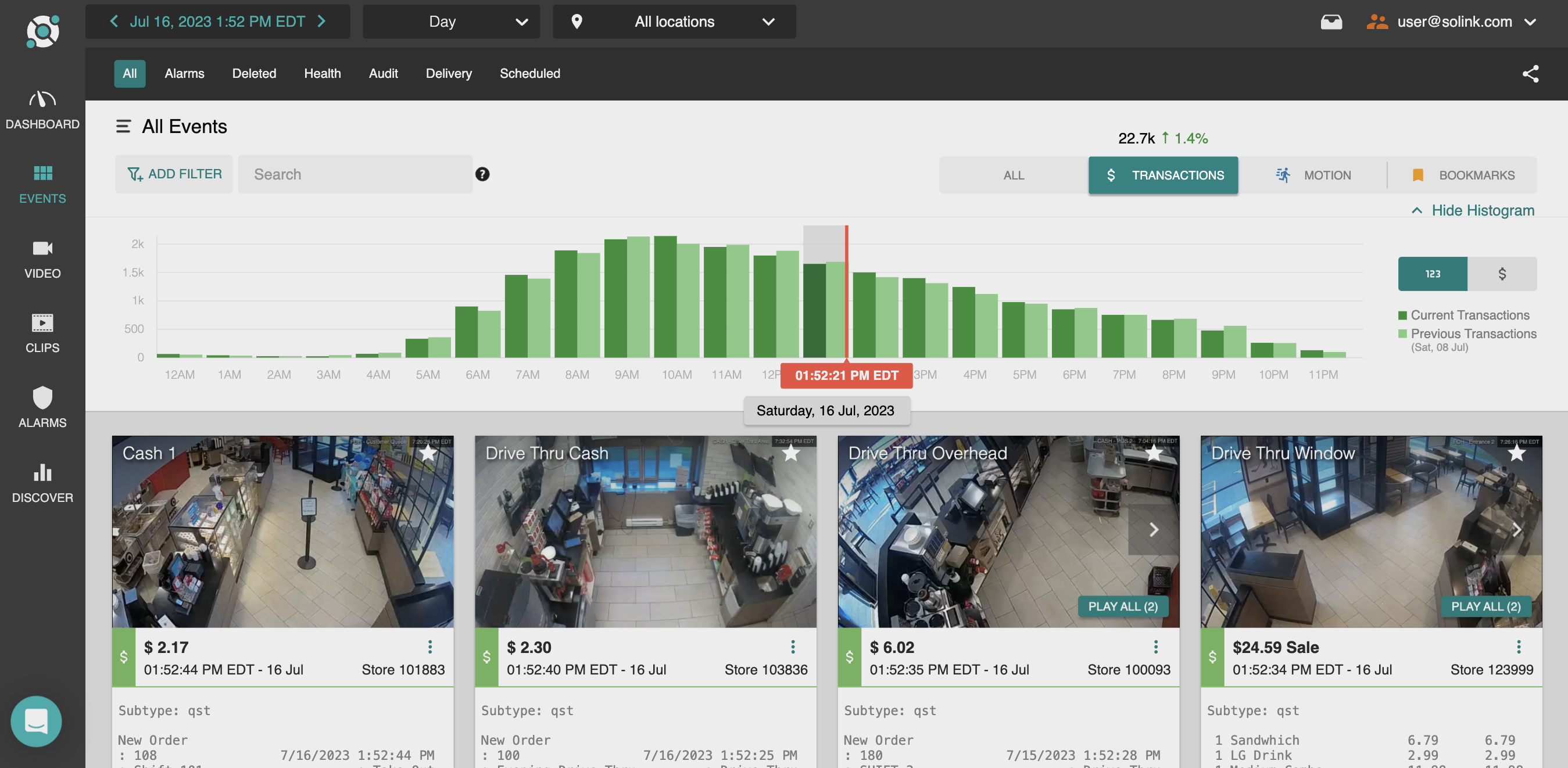
As the business expanded into Hawaii and Guam, Solink scaled alongside it to support consistent visibility across what is now an 88-location operation. Today, district managers use the platform daily to monitor and validate POS activity — reviewing voids, refunds, and drawer activity to ensure transactions are legitimate and not a form of manipulation.
Beyond POS oversight, Solink has become a core operational tool. District managers pair weekly sales-by-hour reports with video evidence to investigate outliers at specific locations, helping them quickly determine whether dips in performance are due to staffing gaps, process issues, or external factors like road construction.
The platform also helps Urbina’s team effectively manage different challenges across different markets. In Hawaii, where labor shortages are common, district managers use Solink on their phones to monitor store conditions in real time so they can respond quickly if staffing issues arise. In Seattle, where staffing levels are more stable but demand can fluctuate, the team uses Solink to ensure labor is aligned with sales and stores are operating as efficiently as possible.
For Urbina, one of the biggest benefits of rolling out Solink across all locations has been stronger control over food costs and avoidable loss.
That improvement came from being able to better identify and address issues like untracked employee meals, unrecorded transactions, and unexplained voids or refunds. Urbina estimates that voids are down by 80 to 85% since implementing Solink, as district managers can review voids in minutes and share clips directly with store teams. This allows them to coach employees in the moment with real examples.
After expanding beyond the initial pilot, the business also saw sales rise by about 3%, driven by more consistent oversight and better alignment of staffing with customer demand.
Today, the team continues to build on those improvements by using Solink to monitor shift changes, minimize waste, and verify that restaurants are operating as they should throughout the day — for example, checking that the drive-thru isn’t blocked by a cone, or confirming that dining rooms are open and ready for customers.
For Urbina, Solink’s impact comes from improved visibility, accountability, and consistency across every location. By giving his team the ability to quickly verify what’s happening in each restaurant, they’ve been able to drive more sales, reduce avoidable loss, and respond faster to the unique operational challenges of each market.
For operators considering a similar investment, his advice is to focus on the long-term value and make sure teams are equipped to get the most out of the platform.