
INSIGHTS

Why AI agents are the perfect solution for modern restaurant operations

June 16, 2026

Table of Contents

Executive summary

AI agents are changing restaurant operations by helping teams move from reactive management to faster, more proactive decision-making. This technology has emerged because the old model of manual review and disconnected systems is no longer fast enough. This explores how AI agents are helping to run and improve restaurant operations.

Key takeaways
  • AI agents are about action, not just analytics
  • Restaurant operations are becoming too complex for manual review alone
  • Off-premise dining, labor pressure, and food waste are major reasons operators are rethinking their tech stack
  • Video is becoming operational data, not just security footage
  • AI agents work best when they have context from POS, labor, video, alarms, and operational systems
  • Solink helps provide that context by connecting video with the systems that drive restaurant decisions
Is your restaurant drowning in data? The problem has never been collecting that data – whether it be sales, labor, inventory, guest feedback or security – it’s deciding what deserves your attention. 

That’s why AI agents can significantly enhance how you run your restaurant operations. You don’t want another dashboard to add to your workload. You need a better operating model that automates tasks, helps you prioritize where you will get the biggest bang for your buck, and frees you up for higher-value work.

And as restaurant operations become more complex – with takeout, delivery and drive-thru now counting for a staggering 75 percent of all restaurant traffic and labor representing a medium of 30 percent of sales for profitable restaurants and 34% for unprofitable ones (a slim margin for error indeed)  –  AI agents are becoming increasingly important. 

AI agents do not replace managers. They help managers act faster, with better context, and with less manual work.
Transform restaurant operations with Solink AI
Discover how AI-powered insights help restaurants operate smarter every day.

What is an AI agent?

An AI agent is a solution that can operate toward a defined goal, monitor data sources, identify exceptions, make decisions based on rules or context, and trigger actions with minimal human involvement.

That is different from a dashboard. A dashboard tells you what happened. An AI agent helps determine what should happen next.

In a restaurant, that might mean:

  • Identifying a suspicious refund pattern
  • Pulling the related video clip
  • Drafting an incident summary
  • Notifying the right manager
  • Creating a follow-up task automatically

That is the important shift. AI agents are not just answering questions. They are helping carry out work. For restaurant operators, that matters because the biggest challenge is usually not awareness. It is visibility, coordination, and, ultimately, action. 

Why restaurant operations are ready for AI agents

Restaurant operations have become too complex to run by memory, intuition, and manual review alone. The business environment now includes:

  • More off-premise orders than ever
  • More labor pressure
  • More channel complexity
  • More shrink and fraud risk
  • More expectations from customers
  • Less room for error

What does this mean? Complex physical environments, thin margins, and too many recurring decisions for people to handle manually at scale. The result is a workload that grows faster than the management team can reasonably absorb. 

AI agents help by reducing the amount of repetitive work humans have to do before they can make a good decision.
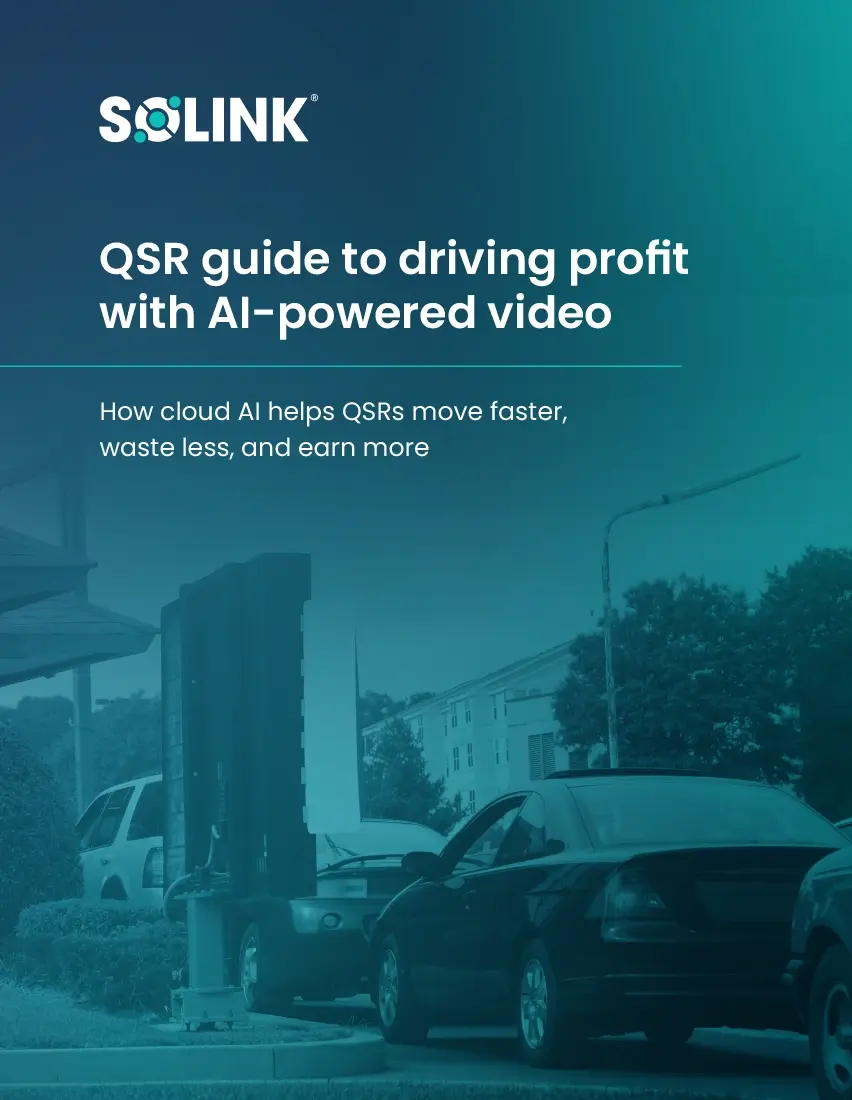
A drive-thru lane with cars waiting; the Solink QSR guide discusses how cloud AI video helps quick service restaurants increase profit, efficiency, and reduce waste.

QSR guide to driving profit with AI-powered video

A drive-thru lane with cars waiting; the Solink QSR guide discusses how cloud AI video helps quick service restaurants increase profit, efficiency, and reduce waste.
Little things add up fast in a high-volume QSR environment. Hidden inefficiencies like inconsistent service between stores, drive-thru and front counter bottlenecks, and employee theft will quietly eat into your profit, adding up to big losses over time.

You can’t fix what you can’t see, and that’s where AI comes in. The best AI cloud technology pulls together your video, POS, and operational data into one clear view so you can spot issues early, fix them fast, and keep things running smoothly.

The five decisions AI agents can improve in restaurant operations

1. Labor decisions

Labor is one of the biggest controllable costs in restaurants, and it is also one of the hardest to manage consistently.  An AI agent can help identify:

  • Understaffed periods before service suffers
  • Overstaffed shifts that drag margins
  • Stores where productivity is consistently below benchmark
  • Patterns where service speed and staffing do not match demand

The value is not just forecasting. It is prioritization. AI can help leaders focus on the stores and time periods where a labor adjustment will matter most.

2. Food cost and waste decisions

Food waste is one of the quietest ways restaurants lose money. Toast reports restaurants are leaving approximately $2 billion in profits on the table due to food waste. 

That loss often comes from repeated behavior, such as:

  • Over-prepping
  • Inconsistent portioning
  • Weak storage discipline
  • Unnoticed spoilage
  • Misaligned production with demand

An AI agent can identify the patterns that lead to waste and surface them before they become routine. That turns food waste from an after-the-fact writeoff into a preventable operational issue.

3. Service speed decisions

Speed still matters. In Intouch Insight’s 2025 Drive-Thru Study, the “Classic” segment averaged 5 minutes and 9 seconds total service time, but the report notes that AI-enabled drive-thru performance was even faster

For operators, the real question is not just how fast the drive-thru is. It is why the drive-thru slows down. An AI agent can help spot:

  • Queue buildup
  • Handoff delays
  • Staffing gaps
  • Bottlenecks during peak periods
  • Stores with recurring service drift

That matters because small service delays compound quickly in a restaurant environment.

4. Loss prevention decisions

Loss prevention is not separate from restaurant operations. It is part of them. AI agents can help flag:

  • Refund spikes
  • Void patterns
  • Unusual discounts
  • No-sale drawer activity
  • Repeat exceptions by shift, store, or manager

That is especially valuable in multi-location environments where a small pattern in one location may actually be part of a broader issue.

This is where context matters. A POS report can show a refund occurred. But a restaurant operator needs to know what actually happened. That is why pairing AI workflows with video and transaction data is so powerful.

5. Safety and incident decisions

Restaurants are physical environments with real risk, such as slips, customer disputes, after-hours alarms, and aggressive interactions. AI agents can help by:

  • Gathering incident context faster
  • Creating incident summaries
  • Escalating events to the right team
  • Preserving evidence for follow-up
  • Reducing the time managers spend rebuilding what happened

That is not just a security advantage. It is an operational advantage.
Unlock operational efficiency with Solink
Learn how AI agents help restaurants improve performance and profitability.

Why video is the missing context layer to improve restaurant operations and increase profitability

AI agents are only as useful as the data they can see. A refund event without video is incomplete. A staffing issue without location context is incomplete. A food waste issue without operational evidence is incomplete.

This is where video becomes operational data.

Video can show:

  • Why a line formed
  • Why a refund was issued
  • Why a procedure drifted
  • Why a safety issue escalated
  • Why a store underperformed

That is why restaurant analytics software and AI workflows are becoming more valuable when they include video intelligence. Solink is changing the game here because it connects existing cameras to POS, alarms, and operational data – turning video into a practical decision layer instead of just a record of what happened.

What a restaurant AI-agent stack should include

The strongest restaurant AI-agent programs are not built on one system. They are built on a stack.

At minimum, that stack should include:

  • POS systems to show what sold
  • Inventory systems to show what should have been used
  • Labor systems to show who worked
  • Video intelligence to show what happened
  • AI analytics to identify patterns
  • AI agents to recommend and initiate action

How to get started with AI agents in your restaurant responsibly

The smartest way to adopt AI agents is not to automate everything at once. Start with one workflow that is repetitive, measurable, and high-value.

Good candidates include:

  • Refund and exception review
  • Drive-thru bottleneck detection
  • Incident response workflows
  • Food waste pattern detection
  • Labor variance review

Then define success before you launch:

  • What problem are you solving?
  • What time are you trying to save?
  • What outcome do you want to improve?
  • Who owns the follow-up?

That is how AI becomes a real operational advantage instead of another technology experiment.

How Solink fits

Solink’s AI Agents become digital teammates for your restaurant, helping your business to see more, know more and do more at scale. 

As an AI-driven video intelligence solution, Solink works with existing cameras and connects video to POS, alarms, and other operational signals. This gives AI Agents the context they need to drive value for your business. 

In practice, Solink helps restaurant leaders:

  • Investigate incidents faster
  • See what actually happened in the restaurant
  • Identify recurring operational patterns
  • Improve consistency across locations
  • Reduce the time managers spend chasing information

If restaurant operations are moving toward more autonomous workflows, visibility is the foundation. Solink provides that foundation.

Interested in seeing first-hand how Solink can benefit your business, giving you insights that increase restaurant profitability? Book a demo today.
Optimize every shift with Solink AI
Explore how AI agents help restaurants reduce waste and improve service.

FAQ: Using AI agents to help run restaurant operations

What are AI agents in restaurant operations?
AI agents are systems that can monitor data, identify exceptions, recommend actions, and trigger workflows with minimal manual input.
They help restaurants improve labor decisions, reduce food waste, speed investigations, strengthen loss prevention, and respond faster to operational issues.
No. They reduce repetitive administrative work so managers can spend more time making decisions, coaching teams, and improving operations.
The best starting points are repetitive, high-volume workflows such as refund review, service bottleneck detection, incident documentation, and waste pattern analysis.
Video provides the real-world context that helps AI agents understand what actually happened, rather than relying only on transaction data or reports.
Solink connects video with POS, alarms, and operational data, giving AI agents the context they need to support faster decisions and more consistent workflows.