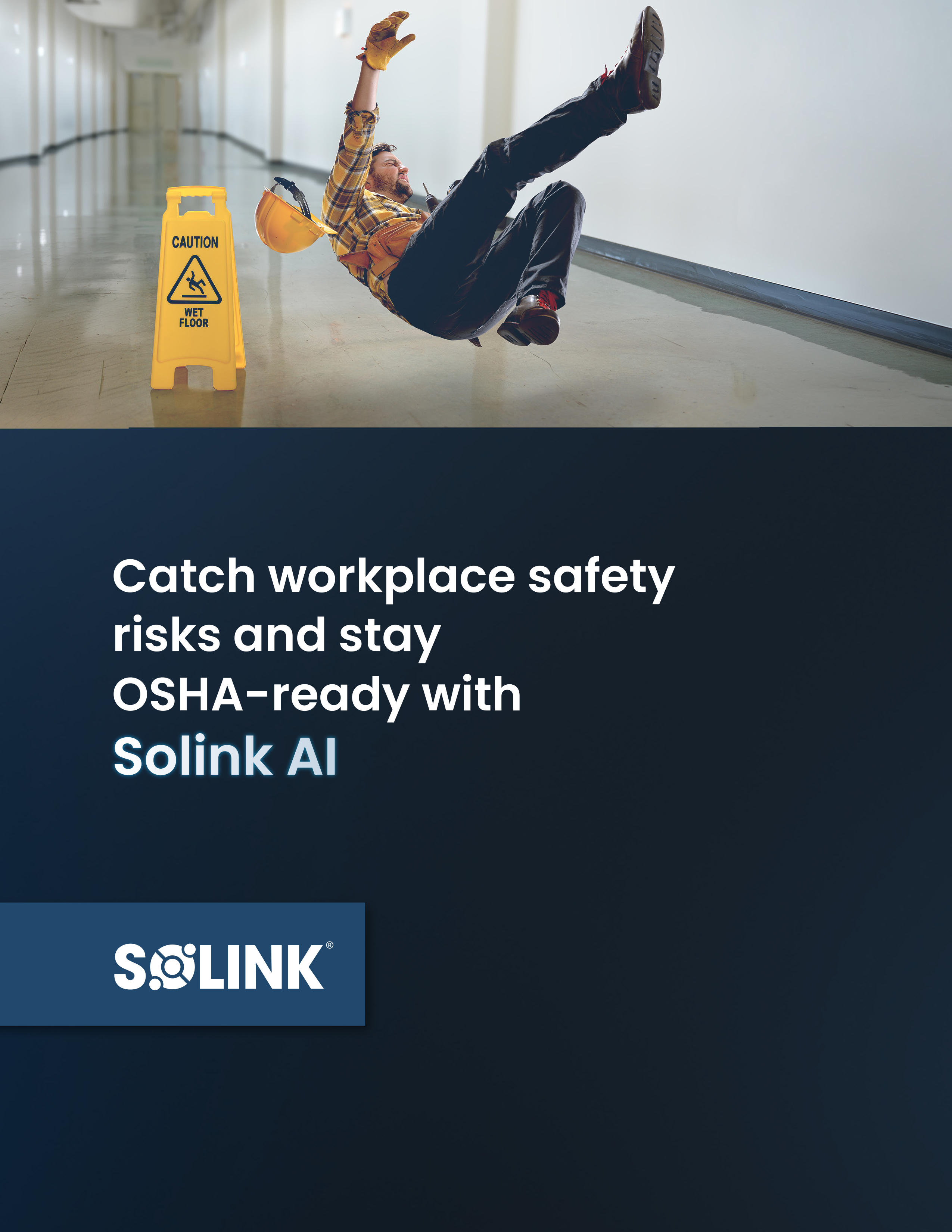
Business complexity and workplace safety: How AI helps build safer workplaces
Modern workplace safety requires more than policies, especially as business complexity grows. Learn how AI and video intelligence help organizations proactively identify risks, improve safety programs, and protect their people.
Guide to OSHA compliance with AI-driven video intelligence
As businesses grow, workplace safety becomes more complex. More employees, multiple locations, evolving regulations, labor shortages, and increasingly sophisticated operations all make it harder to keep people safe while maintaining productivity.
The challenge isn’t simply preventing accidents anymore. Today’s organizations must proactively identify risks, prevent workplace violence, maintain compliance, investigate incidents quickly, and create a culture where safety becomes part of every decision.
According to the US Bureau of Labor Statistics, employers reported 2.6 million nonfatal workplace injuries and illnesses in 2023, while 5,283 workers lost their lives on the job. As organizations become larger and more operationally complex, identifying and preventing workplace risks has become increasingly challenging.
Technology is changing how businesses approach these challenges. Artificial intelligence (AI), video analytics, and connected workplace safety software are helping organizations move beyond reactive safety programs toward proactive, data-driven workplace safety strategies.
That’s where Solink comes in. By combining AI-driven video intelligence with business data, Solink helps organizations improve workplace visibility, reduce risk, strengthen compliance, investigate incidents faster, and create safer working environments.
This guide explores how business complexity affects workplace safety, how AI is transforming modern safety programs, and the practical steps organizations can take to better protect their employees.
Why business complexity is changing workplace safety
Today’s workplaces are significantly more complex than they were even a decade ago. They now manage; multiple locations; larger workforces; hybrid and rotating schedules; contractors and temporary staff; higher customer expectations; more operational data; and greater regulatory requirements than ever before.
McKinsey concludes that these are deep structural transformations that are fundamentally increasing organizational complexity and requiring businesses to rethink how they operate.
A warehouse operator may need to monitor forklift traffic, loading docks, visitors, contractors, and inventory movement simultaneously. A restaurant manager may oversee food safety, employee safety, customer interactions, cash handling, and security with a small team. Retail managers balance customer service, theft prevention, employee safety, and compliance across multiple shifts.
As businesses become more complex, traditional workplace safety programs often struggle to keep pace.Rather than relying solely on policies and manual inspections, organizations are increasingly using AI, automation, and video intelligence to identify risks before incidents occur.
What is a modern workplace safety program?
A workplace safety program is more than a collection of policies or compliance requirements. An effective program creates systems that help organizations identify hazards, reduce risk, train employees, investigate incidents, and continuously improve workplace safety.
Modern workplace safety programs typically include:
Safety policies and procedures
Hazard identification
Risk assessments
Incident reporting
Employee training
Workplace violence prevention
Safety audits
Compliance monitoring
Continuous improvement
Increasingly, organizations are adding AI-driven technologies that provide greater visibility into workplace operations and help safety teams respond faster when issues arise. The goal is simple, identify risks before they become injuries.
Why proactive workplace safety matters
Many organizations still operate reactively. An incident occurs. Someone reports it. Management investigates. Corrective action follows.
While this approach satisfies reporting requirements, it rarely prevents the next incident. A proactive safety program focuses on identifying risks earlier.
This includes:
Unsafe behaviors
Near misses
Operational bottlenecks
Equipment misuse
Restricted-area access
Workplace violence indicators
Process breakdowns
The National Safety Council estimates workplace injuries cost employers more than $176 billion annually in wage losses, medical expenses, administrative costs, and productivity losses. Preventing even a small number of incidents can create significant financial and operational benefits.
Workplace safety tips every business should follow
Strong workplace safety programs begin with consistent daily habits rather than reacting to major incidents. Some of the most effective workplace safety practices include:
Conduct regular safety inspections
Encourage employees to report hazards
Keep work areas organized
Review incidents and near misses
Train employees regularly
Establish clear emergency procedures
Monitor compliance with safety protocols
Investigate every incident thoroughly
The challenge is maintaining these practices consistently across every shift and every location. Technology can help by providing greater visibility into day-to-day operations and highlighting where procedures are not being followed.
How workplace safety software simplifies safety management
As organizations grow, spreadsheets and paper-based reporting quickly become difficult to manage. Modern workplace safety software – which comes in many different forms – helps centralize safety information while giving managers better visibility into incidents, compliance, inspections, and corrective actions.
Good workplace safety software helps organizations:
Standardize reporting
Track incidents
Monitor corrective actions
Improve compliance
Manage documentation
Identify recurring safety issues
Measure performance over time
Instead of managing safety reactively, organizations gain the ability to continuously monitor and improve workplace performance. As workplace complexity increases, centralized software becomes increasingly important for maintaining consistency across locations.
Artificial intelligence is changing how organizations think about workplace safety. Rather than simply documenting incidents after they occur, AI helps organizations identify risks in real time and respond more quickly.
AI can help organizations; detect unsafe behaviors; monitor restricted areas; identify operational risks; surface safety trends; reduce investigation time; improve compliance monitoring; and prioritize incidents.
For workplace safety teams, that means spending less time reviewing footage and reports and more time preventing incidents.
It’s important to note that AI does not replace safety professionals. It gives them better information so they can make faster, more informed decisions, and spend their time on high-value tasks.
One of the biggest shifts in workplace safety is moving from passive video recording to proactive video intelligence. Traditional cameras record what happened, but video analytics helps organizations understand:
Why it happened
Whether procedures were followed
Where operational risks exist
Which locations require attention
How incidents can be prevented
Artificial intelligence takes that one step further, helping businesses to use their video intelligence system to automatically identify:
Unsafe work practices
Unauthorized access
PPE compliance issues
Congested work areas
Equipment misuse
Near misses
Instead of reviewing hours of footage after an incident occurs, safety teams can quickly investigate events and identify opportunities for improvement. Video becomes more than evidence. It becomes a tool for prevention.
One of the fastest-growing workplace safety concerns is workplace violence. Violence can occur between employees, customers, visitors, contractors, or individuals with no legitimate connection to the business.
According to the Occupational Safety and Health Administration (OSHA), workplace violence is one of the leading causes of work-related fatalities in the United States and accounts for a significant number of serious workplace injuries each year.
Understanding the different types of workplace violence helps organizations develop more effective prevention strategies. Workplace violence can include:
Criminal intent
Customer or client violence
Worker-on-worker violence
Personal relationship violence
Each type presents different warning signs, risks, and prevention strategies. Recognizing those differences is essential when building a comprehensive workplace safety program.
How to prevent workplace violence before it happens
Whether you’re managing a retail store, restaurant, warehouse, manufacturing facility, healthcare organization, or corporate office, protecting employees requires more than reacting to incidents after they occur. Organizations with strong prevention programs are better positioned to identify risks early, respond appropriately, and create safer working environments.
Effective workplace violence prevention starts long before an incident occurs. A proactive program should include:
Clear workplace violence policies
Employee reporting procedures
Threat assessment processes
Incident investigation procedures
Emergency response plans
Ongoing training
Regular policy reviews
Technology also plays an increasingly important role. AI-driven video intelligence helps organizations improve visibility into their workplaces by identifying unusual activity, supporting investigations, and helping managers respond faster when incidents occur.
While technology cannot prevent every incident, it can provide valuable context that helps organizations make better safety decisions and continuously improve their prevention strategies.
The strongest workplace violence prevention programs combine people, policies, training, and technology into a single, coordinated approach.
Why workplace violence prevention training matters
Even the best workplace safety policies are only effective if employees understand them. Training gives employees the knowledge and confidence to recognize risks, report concerns, and respond appropriately during difficult situations.
Effective workplace violence prevention training should help employees understand; the different types of workplace violence; warning signs of escalating behavior; how to report safety concerns; emergency response procedures; de-escalation techniques where appropriate; company reporting policies; and personal safety best practices.
Training should not be treated as a one-time onboarding activity. Organizations with strong safety cultures reinforce workplace violence awareness through ongoing education, regular discussions, and continuous improvement.
Video is also a highly-effective training tool. With permission and appropriate privacy controls, organizations can use real workplace events to demonstrate best practices, identify process improvements, and reinforce safety procedures using visual examples rather than written documentation alone.
AI-driven video search makes it easier to find relevant events for coaching while reducing the time required to prepare training materials. This creates more engaging, practical training that employees are more likely to remember and apply.
Technology alone does not create safer workplaces. The organizations with the strongest safety records build cultures where safety becomes part of everyday decision-making.
A proactive safety culture encourages employees to:
Report hazards without fear
Share near misses
Participate in safety discussions
Identify opportunities for improvement
Support one another
Follow established procedures consistently
Leadership plays an equally important role. Managers who regularly review incidents, recognize safe behaviors, investigate root causes, and communicate openly about safety create environments where employees feel empowered to speak up before problems become serious.
AI and video intelligence strengthen this culture by providing objective information instead of assumptions. Rather than relying solely on memory or written reports, managers can review what actually happened, understand contributing factors, and identify opportunities to improve processes rather than assign blame.
This shift from reactive investigations to continuous learning is one of the biggest advantages of modern workplace safety technology.
The business value of investing in workplace safety
Some organizations still view workplace safety primarily as a compliance requirement. In reality, workplace safety is a business performance initiative.
Safer workplaces often experience:
Lower injury rates
Reduced downtime
Lower workers’ compensation costs
Higher employee morale
Improved retention
Better operational consistency
Reduced legal exposure
Stronger customer confidence
The Liberty Mutual Workplace Safety Index estimates that the leading causes of serious workplace injuries cost US businesses tens of billions of dollars in direct workers’ compensation costs every year.
Preventing even a small number of incidents can create meaningful financial returns while protecting employees and strengthening organizational culture.
When AI, video intelligence, and workplace safety software work together, organizations gain greater visibility into daily operations and can identify opportunities to improve both safety and overall business performance.
See workplace safety in action
One of the best ways to understand the value of AI-driven workplace safety is to see how organizations are already using it to improve operations.
Businesses across industries are using video intelligence to strengthen safety programs, improve operational visibility, reduce investigations, and create more consistent workplace procedures.
Rather than adding more manual processes, they are using technology to simplify investigations, identify opportunities for improvement, and help managers make faster, more informed decisions.
How Solink helps organizations build safer workplaces
Managing workplace safety has never been more complex. Organizations are expected to protect employees, maintain compliance, investigate incidents quickly, and continuously improve safety performance across multiple locations.
Instead of reacting after incidents occur, with Solink organizations can proactively identify opportunities to improve workplace safety while supporting operational excellence.
Whether you operate retail stores, restaurants, automotive dealerships, warehouses and logistics facilities, manufacturing sites, or regulated environments, Solink helps transform video into actionable operational intelligence that protects people as well as profitability.
If you’re ready to simplify workplace safety while improving visibility across your business, Solink is built to help.
Book a demo to see how Solink helps organizations build safer workplaces with AI-driven video intelligence.
Simplify workplace safety with Solink
Learn how AI helps your team identify risks before they become incidents.